
Prince George’s County Release Meaning
A Prince George’s County release means that one custodian’s control ended or changed. It does not always mean the person walked free. The Prince George’s County Department of Corrections, or PGCDOC, operates the local adult jail and maintains a computerized case record from intake through release. The department, not the Sheriff, is the first source for an exit from the Correctional Center. That exit may be a bond release, time served, sentence completion, dismissal, a court order, or a move into a county program. It may instead be transport to a Maryland prison or transfer to another authority.
The last distinction is vital. A person moved from Dille Drive to the Maryland Division of Correction remains confined. Someone taken by another county, federal officials, or immigration authorities has left PGCDOC custody but has not returned to the community. A valid Prince George’s County released inmate record should answer who was held, when local custody ended, why it ended, and where the person went. Name alone is weak proof. Match a date of birth or agency number when the source lawfully provides one.
- Discharge
- The end of the sentence or custody obligation, not merely a move between facilities.
- Time served
- A release based on confinement already credited toward the sentence.
- Parole
- Conditional community release while a state sentence continues.
- Probation
- Court-ordered community supervision that may follow custody or replace a jail term.
- Detainer
- A notice that another authority may assume custody when the present custodian releases the person.
Prince George’s County Release Types
The type of exit controls the next search. A pretrial release ends secure jail custody while the criminal case is still open. A sentence release follows the court’s term and the credits calculated by PGCDOC. Transfer is a change of jailer, not a community release. The Release Unit’s actual entry is more reliable than a guess based on disappearance from a locator.
| Release or exit type | What it means | Where to verify next |
|---|---|---|
| Bond or recognizance | Secure county custody ends, but charges remain pending and conditions may apply. | PGCDOC Release & Records and Maryland Judiciary Case Search |
| Time served or sentence expiration | The county term ends after sentencing credit and eligible diminution credits are applied. | PGCDOC release record and the sentencing docket |
| Dismissal or court order | The court supplies the legal basis, subject to processing and any separate hold. | District or Circuit Court docket plus the Release Unit |
| Parole or mandatory supervision | Confinement may end while the sentence and conditions continue. | Release institution, VINE, court record, and Division of Parole and Probation |
| State prison transfer | The person leaves county custody for Maryland DOC custody. | DPSCS current locator after state intake |
| Another-authority transfer | Another county, federal agency, or immigration authority assumes control. | The receiving authority’s record or locator |
Does leaving the roster prove release? No. Prince George’s County has no public adult roster, and a missing record in any current-custody tool can reflect transfer, delayed data, exclusion, another name, or release. Confirm the recorded event and destination.
Prince George’s Release Record Fields
PGCDOC states on its Incarcerated Individuals Release & Records page that its Records Unit maintains an individual case file and computerized record from intake through release. The public website does not expose that database or promise that each internal field will be disclosed. A narrow request should identify existing data that can establish the exact custody event. Ask for the smallest useful set and allow the custodian to apply lawful redactions.
| Requested field | What it can show |
|---|---|
| Legal name and PGCDOC identifier | Which individual case file and booking event the record concerns |
| Admission date and time | When the documented county custody period began |
| Releasing facility | Whether the event came from the Correctional Center or another county program |
| Actual exit date and time | When PGCDOC finished processing the release or transfer |
| Disposition or legal basis | Bond, order, time served, sentence end, transfer, or another recorded reason |
| Destination or receiving authority | Whether the person entered the community or another authority’s custody, if releasable |
| Booking photograph | The image tied to that admission, if maintained and disclosable |
Release papers held by the person can also corroborate processing. They should be read for the kind of exit and any stated obligations. They do not rule out a later arrest or another authority’s pickup. No verified source gives a universal PGCDOC retention period, so an older-record request should ask which agency schedule governs the file.
Note: Requested fields are targets for an existing record, not a promise that PGCDOC must disclose every internal item.
Request Prince George’s Release Records
Start with the office that can resolve the event quickly. Call Records/Inmate Locator at 301-952-7102 or Release & Records at 301-952-7158. Ask whether the person remains in PGCDOC custody. If not, ask whether the recorded exit was a community release or transfer and whether the actual date can be given. When a document is needed, use the county Maryland Public Information Act portal and direct the request to Corrections.
- Identify the person by full legal name and, when known, date of birth or PGCDOC number. Give an approximate custody period.
- Ask for the existing intake and release record, limited to admission, actual release or transfer, disposition, releasable destination, and any needed booking image.
- Request an electronic copy. Ask for a fee estimate before chargeable work begins and offer to inspect the record if that lowers cost.
- Review the response for the actual exit time and the community-release-versus-transfer classification. Compare it with the court order.
- If the response is delayed, use Maryland’s statutory timing rules and ask which retention schedule applies if no record remains.
Captain Damian Green
13400 Dille Drive
Upper Marlboro, MD 20772
301-952-7304
The first two hours of county search and preparation are free. Reasonable search, review, redaction, and copy costs may follow. Under General Provisions §4-203, an agency generally grants or denies access promptly and within 30 days. If production will take more than 10 working days, the custodian must give a written estimate of time, reason, and fees within that initial period.
General Provisions §4-206 governs reasonable actual costs and allows fee waivers in qualifying cases. Access still has limits. Under §4-351, a custodian may withhold investigatory material when disclosure would cause listed harms, invade privacy, impede enforcement, expose protected methods, or put a person at risk. State prison case records face separate correctional confidentiality rules. That is why a Prince George’s County release date or photograph should be requested and reviewed, not described as automatically public in every case.
When Prince George’s Releases Finish
A court decision and a physical exit run on different clocks. Prince George’s County publishes a normal release-processing wait of four to six hours, depending on release type. Family or friends may wait in the public Reception area, but they should first confirm that no additional charge blocks the anticipated exit. Release staff must check records, legal authority, and other holds before the person can leave.
For weekday bond-review results, county guidance directs callers to 301-952-7102 after 5:30 p.m. A favorable result is not the final timestamp. Use the Release Unit’s actual processing entry when the exact exit matters. This also explains why a custody notification, court docket, and family pickup can reflect the same event at different moments.
Important: A signed release order supports the legal basis, but PGCDOC records confirm whether physical county custody actually ended.
Getting Home After County Release
The Correctional Center’s release transportation instructions publish bus and evening van options for people leaving Dille Drive. County bus service runs toward the Upper Marlboro courthouse and county administration area and toward the Addison Road and New Carrollton Metro stations. A newly released person who lacks fare may show release papers to ride the bus without paying. Those papers therefore serve as both proof of processing and a transit credential.
Free evening van service is listed toward the courthouse, Landover Metro, Addison Road Metro, and Penn Mar Shopping Center. The online timetable is undated, so confirm the route and timing at 301-324-2877 before planning a pickup or connection. Transportation availability does not answer the legal-status question. First verify that processing is complete, then use the current route information.
Note: Keep the release papers accessible during the trip because the county identifies them as the no-fare proof for a person without money.
Prince George’s Bond Release Status
PGCDOC performs pretrial work as well as secure detention. Staff interview new admissions, gather information used in release decisions, and monitor some court-ordered conditions. A bond or recognizance exit therefore moves a person out of secure custody while the case remains pending. It does not mean dismissal, sentence completion, or discharge.
Check the county line for the bond-review result, then inspect Maryland Judiciary Case Search for the bond event and later docket entries. The person may be assigned to Pretrial Release or Home Detention. Another warrant or hold can prevent the expected exit even after one case supports release. Ask PGCDOC whether release processing is complete and whether any transfer occurred. The precise language matters because “bond granted,” “released from jail,” and “case ended” describe three different facts.
Prince George’s Community Release Placement
The county’s Community Corrections Division includes the Community Release Center and a Re-entry Services Unit that performs discharge planning for county-sentenced people. The Center reopened in April 2024. County budget material described roughly 25 residents served and an early average of five residents per month. Those are program figures, not county release totals.
Entry into the Community Release Center is not full discharge. A resident has substantial community access but must return and comply with the structure of the placement. Successful completion can end that obligation and return the person fully to the community. A violation or new court action may lead back to secure custody. Verify the person’s exact status through PGCDOC, the court, DPSCS, or the Division of Parole and Probation, depending on who ordered and oversees the placement.
Note: Community Release Center admission marks a structured placement change, while successful completion is the distinct community-release event that needs confirmation.
Prince George’s Release Expungement Timing
Physical release can come years before a record becomes eligible for expungement. Maryland’s waiting periods for many eligible convictions run from sentence completion, and sentence completion includes parole, probation, and mandatory supervision. A person may have left the Correctional Center while the sentence and the waiting-period clock have not ended.
Expungement can remove qualifying court and law-enforcement records. Shielding is different. It limits public view of an eligible case without erasing the record. Some favorable results also stop appearing remotely even though a record may remain available at the courthouse. The Maryland Judiciary expungement resource and the court that holds the case provide the proper forms and current eligibility path. Neither a blank online result nor an expunged case proves what happened at the jail door on a given day.
Find Prince George’s Released Inmates
The strongest lookup begins with custody type, not a broad name search. Prince George’s County publishes no adult online roster, released tab, or 24-hour and 72-hour feed. A current-custody roster is therefore not the route for a past county release. Use PGCDOC phone records first, then add the source that explains the legal status.
- Call 301-952-7102 or 301-952-7158. Ask whether the person remains in PGCDOC custody and whether any exit was community release or transfer.
- Search Maryland Judiciary Case Search statewide. Review both Prince George’s District and Circuit Court matches for bond, disposition, sentence, release order, or later action.
- If the county exit may have been a state transfer, search the DPSCS locator. A current match can confirm state confinement after county custody.
- Check Maryland VINE for a matching person and exact live custody wording. Use an earlier notification when one was registered.
- For federal or immigration custody, use the BOP or ICE tool that fits. Do not mix a federal status with a county release.
- Request the existing PGCDOC release record when the phone, court, and notification channels do not settle the actual exit.
Important: A record disappearing from a live system is not proof. It may reflect transfer, escape, a name variation, source limits, protected data, or data lag. The best confirmation pairs the custodian’s release or transfer entry with the court or supervision record that explains why the status changed.
Note: Use two sources when possible because custody records establish the exit while court or supervision records explain the legal status.
Maryland Search for County Releases
The Maryland Department of Public Safety and Correctional Services Incarcerated Individual Locator accepts first and last name and shows the current facility for people within its coverage. It expressly excludes anyone no longer in custody for any reason. It has no public released status, actual release date, projected date, parole field, or historic discharge profile. A name match can show that a person who left county custody entered a Maryland prison. No match cannot show that the person was released.
The official locator view below documents this current-only boundary.
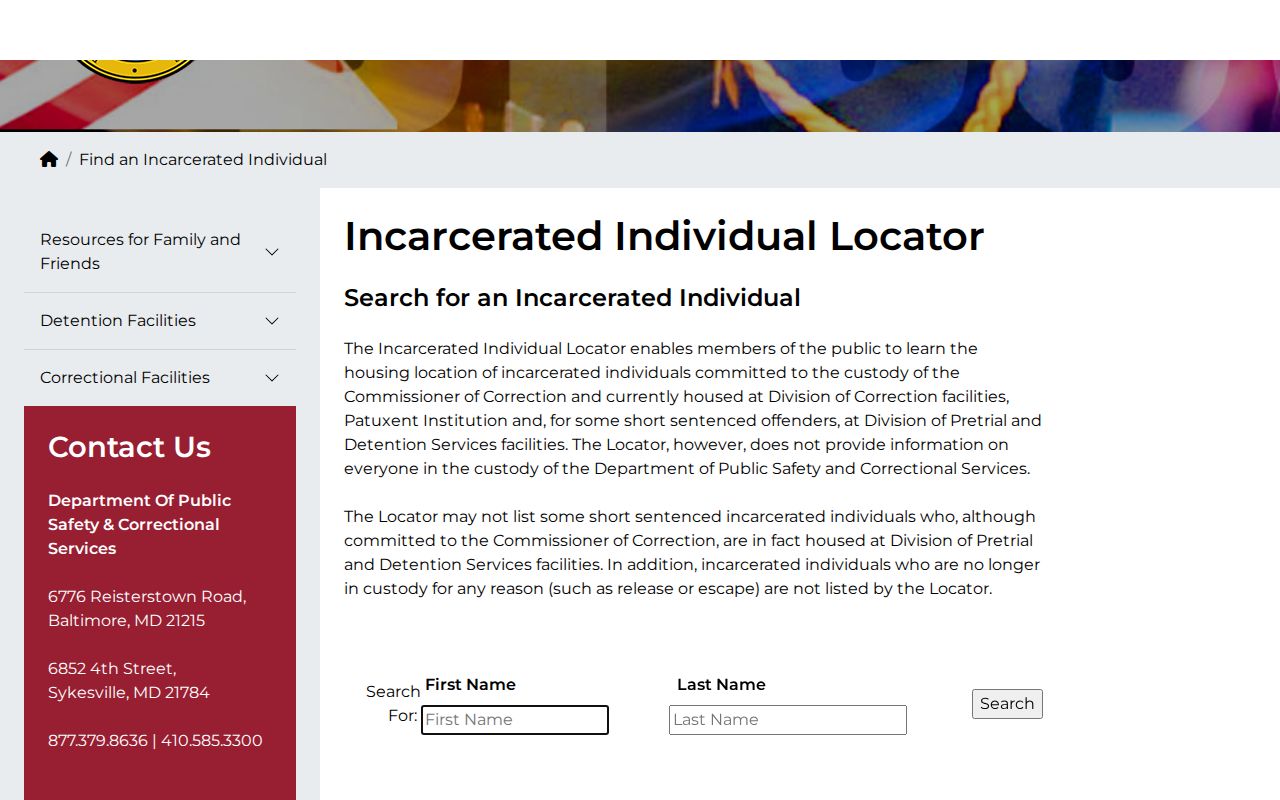
The exclusion notice is the key result: use DPSCS for current state confinement, then use the release institution, DPSCS public-record request, VINE, court docket, or supervision office for a past state discharge.
| System and search fields | Still in custody | Released or transferred |
|---|---|---|
| PGCDOC phone lookup: legal name, birth date or PGCDOC number | Can confirm current county custody | Ask for actual exit and community release versus transfer |
| DPSCS locator: first and last name | Shows a covered current state facility | Removes people no longer in custody, so use DPSCS records and other channels |
| Maryland Case Search: party name, case number, county and case type | May show orders and pending case events | May explain bond, disposition, sentence, and release authority, but not the jail-door time |
| Maryland VINE: legal name or offender number | May show live status and custody location | May show release information or supply a registered notification; no result remains inconclusive |
| BOP locator: name or register number | Shows federal sentence status and location | Can preserve a past federal release date and no-longer-in-BOP status |
| ICE ODLS: A-number and country, or exact name, country and birth date | May show current ICE custody | May retain a recent ICE release for up to 60 days |
Prince George’s Release Court Search
Prince George’s County criminal matters can appear in District Court at Hyattsville or Upper Marlboro and in Circuit Court. A case may start at one level and move to another. Search Maryland Judiciary Case Search statewide and inspect every plausible Prince George’s match. County criminal coverage reaches back to 1982, but older, protected, expunged, and some favorable records may not appear remotely.
Read charges, bond entries, dispositions, sentencing details, probation, commitment, release orders, and later docket activity. “Closed” describes a court case, not physical custody or supervision. A court release order also does not defeat a separate hold. If a favorable result no longer appears online, consult the clerk or courthouse file under the court’s access rules. The signed order and full docket are more authoritative than the online summary, while PGCDOC still supplies the physical exit record.
Note: Search related District and Circuit matters before concluding that one court entry explains the full Prince George’s County release.
Prince George’s Release Notification Search
Maryland VINE is a specific-person custody and notification tool. Search by legal name or offender number, compare available identifiers, and preserve the exact status wording shown. The service may provide custody status, facility location, and release information. It is strongest when a notification was registered before the event. A no-result can reflect a name mismatch, lag, coverage limit, unavailable record, or removal, so it cannot confirm release by itself.
The Maryland-specific VINE screen below shows the official entry point for a Prince George’s County release check.

After a match, users can choose phone, email, text, TTY, or in-app notice options. Phone registrants create a four-digit PIN and enter it when called to confirm receipt. The system may continue its attempts until confirmed. For post-release supervision, Maryland has no public person-name parole or probation search. Contact the appropriate Division of Parole and Probation office and ask what public verification is available.
Note: Registering before release is more reliable than trying to reconstruct an older Prince George’s County custody event after the fact.
County Release Before ICE Custody
An official Prince George’s County statement from April 2025 documents a person whose PGCDOC release was processed before ICE retrieved the person from the public Reception area. The event proves a narrow but important point: release from county custody and return to the community are not synonyms. It does not establish a universal detainer policy, and it should not be stretched beyond that documented case.
When immigration custody is possible, first confirm the PGCDOC event and then check the ICE Online Detainee Locator. ODLS searches with a nine-digit A-number and country of birth, or an exact name, country of birth, and birth date. It can include people released from ICE custody within the prior 60 days. County exit and ICE exit remain separate records. A no-result may reflect lag, security limits, a name issue, or an excluded record rather than community release.
Federal Prince George’s Release Records
The Bureau of Prisons locator applies to federal sentences, not a local PGCDOC stay. It accepts a BOP register number or a name with optional refinements and can display a past release date with “Released” or “Not in BOP Custody” meaning. Those labels only establish BOP status. The person may still face state or local custody, federal supervised release, or another authority. “In Transit” is not release, and a community corrections location may remain within BOP responsibility.
The U.S. Marshals Service has no public prisoner locator. A person held during a federal case may never enter the sentenced BOP system. Federal court records and a narrow USMS Freedom of Information Act request are the fallback. Each federal route must remain separate from the county record. A BOP result cannot prove the time or reason PGCDOC ended a Prince George’s County custody event.
Prince George’s County Release Facilities
Two adult facilities belong in the county release path. The Prince George’s County Correctional Center is the secure local jail. A person may leave it for the community on a court or sentence basis, transfer to Maryland DOC, or move to another authority. The Prince George’s County Community Release Center is a structured community placement, not a second secure jail roster. Completion, court discharge, or a return to custody must be verified according to the resident’s legal status.
Hyattsville Police District I is only a regional processing site. It does not hold a residential jail population or publish a roster. Processing can end with release under a commissioner or court decision, or with transport to Dille Drive. Cheltenham Youth Detention Center is a juvenile facility under the Maryland Department of Juvenile Services. Adult county searches and public-record routes must not be presented as a way to find a youth’s custody or release details.