
Prince George’s Projected Release Dates
A projected date is a working sentence calculation. It begins with the court’s commitment and applies the credits, limits, and later changes that control when confinement may end. An actual release date records what happened after the facility completed its checks. The two can differ. A detainer, another charge, a court modification, lost credit, parole action, or a transfer can change the path before the person reaches the door.
A pretrial detainee has no sentence-based date. The person may leave after bond, recognizance, dismissal, time served, or another order, but the timing depends on the court and PGCDOC processing. At the Prince George’s County Correctional Center, Release & Records maintains the intake-to-release record, while a diminution coordinator projects dates and recalculates credits. “Diminution” means a lawful reduction in the time to be served. That office’s current calculation is stronger than an estimate made from a docket alone.
Find Prince George’s Release Dates
First identify the system holding the person. PGCDOC Release & Records at 301-952-7158 is the direct route for the county jail. Records/Inmate Locator at 301-952-7102 can help establish whether county custody continues. If the person was committed to Maryland DOC, use the state locator only to confirm current location, then contact DPSCS or the release institution for the current sentence calculation. Court records supply the order and sentence terms but not always the facility’s latest credit balance.
- Confirm the legal name, date of birth, and agency number if known.
- Ask PGCDOC whether the person remains in county custody or transferred.
- Review both District and Circuit Court cases for the sentence and later orders.
- For current state custody, identify the institution through the DPSCS locator.
- Ask the correct records office for its current calculated or actual release entry.
- Verify whether another authority or supervision term follows the physical exit.
The Maryland Judiciary Case Search can show charges, dispositions, bond events, sentences, commitments, and later modifications. Search Prince George’s County District and Circuit Court matters because a case can move between them. A signed release order can explain the legal basis, yet a separate hold may still prevent community release. The full search and county release-record route is also covered on the Prince George’s County released-inmates home page.
Maryland Locator Release-Date Limits
The official DPSCS Incarcerated Individual Locator is current-custody only. It searches by first and last name and reports the current facility for covered people. The page states that people no longer in custody for any reason, including release or escape, are not listed. It does not display a public released or discharged profile, actual release date, parole status, or projected release date.
The locator is still useful in one narrow way. A current match can show that someone who left the Prince George’s County jail entered state custody instead of returning to the community. No match proves much less. The person may have been released, escaped, excluded from coverage, entered under another name, or moved beyond the locator’s current scope. Data Processing at 410-585-3350, 410-585-3351, or 410-585-3352 is the official telephone fallback for current state custody and location information.
The state locator source is captured below so its current-only boundary is plain.
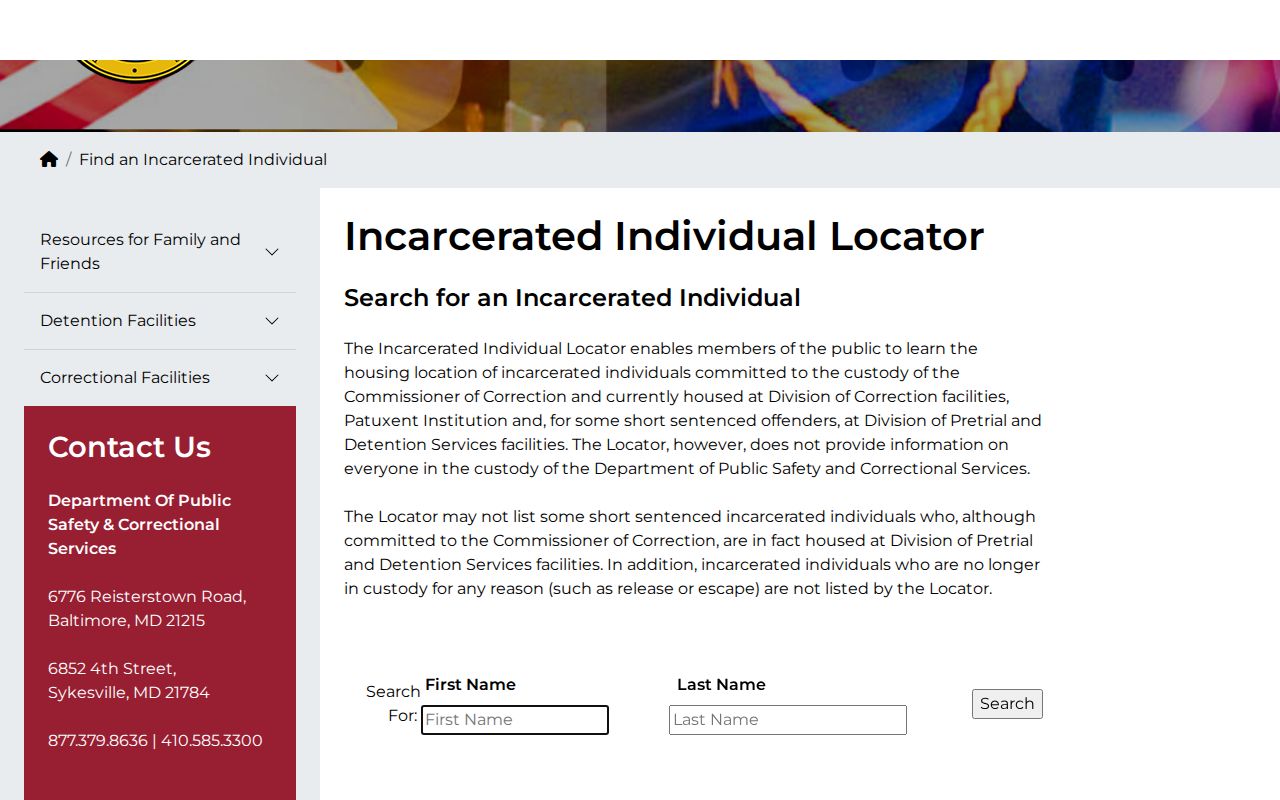
The warning prevents a missing result from being treated as a Prince George’s County inmate release date or as proof of return to the community.
Note: Maryland’s public locator can confirm some current state custody, but it cannot produce a released person’s historical or projected date.
Maryland State Release-Date Credits
For Maryland DOC confinement, Correctional Services §3-704 gives an advance good-conduct deduction from the first through last day of commitment. The general rate is 10 days per calendar month, prorated. When the term includes a concurrent or consecutive sentence for a statutory crime of violence or a specified drug manufacturing or distribution offense, the rate is five days per month. Stayed time, escape time, and time denied credit after parole revocation do not earn that credit.
Other state credits also move the calculation. Section 3-705 permits five days per month for satisfactory assigned work. Section 3-706 covers education. Section 3-707 can allow selected special-work or program credit, while §3-708 limits combined monthly credits. Section 3-709 permits revocation and regulated restoration. Each entry changes the live balance. A disciplinary loss can move a release date later; restored or newly earned credit can move it earlier, subject to the controlling caps.
The state good-conduct statute is shown in the source image below.
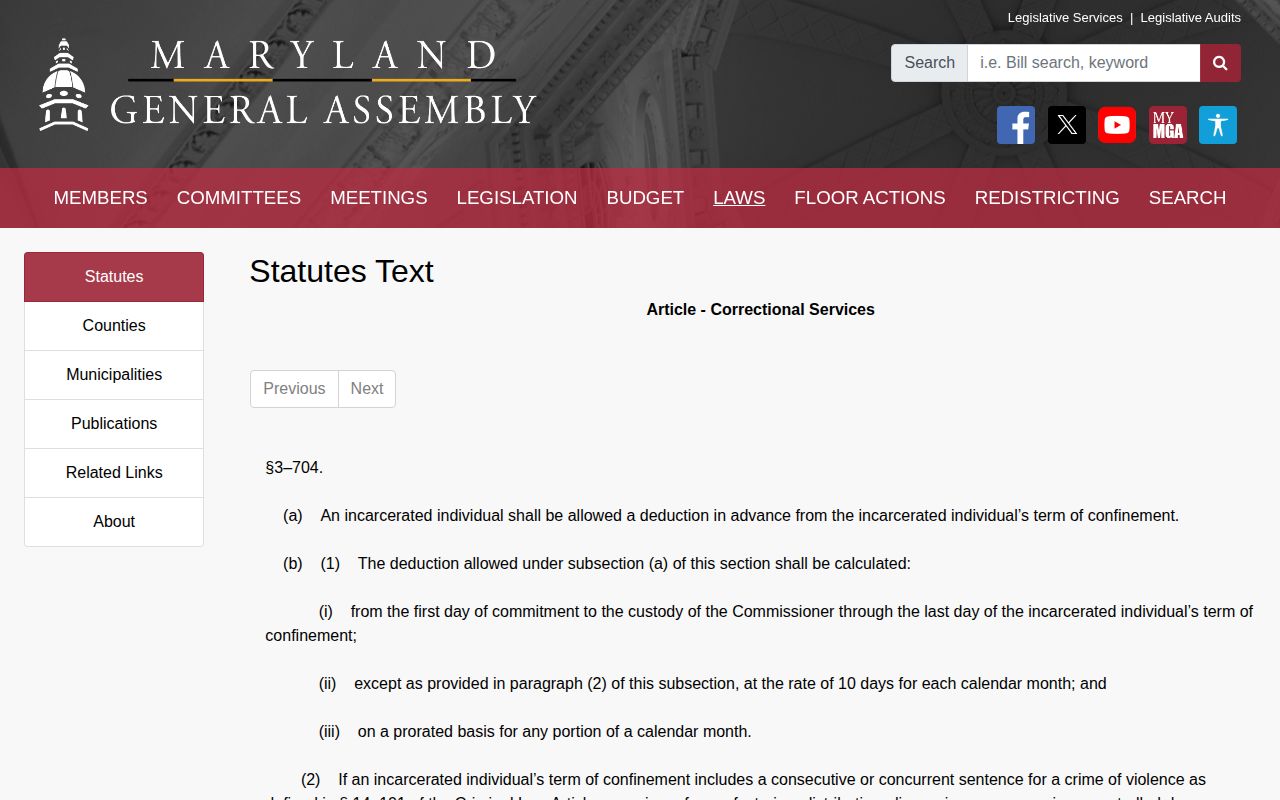
The statute supplies real credit rates, but the institution’s sentence record is still needed to apply them to one person.
Prince George’s Local Release Credits
Local confinement follows a separate Title 11 framework. Section 11-503 generally provides five days per month of presentence good-conduct credit, prorated from arrival until sentencing, commitment to the Commissioner, or release. Section 11-504 supplies the postsentence advance deduction: five days per month for a violent or specified drug sentence and 10 days for other sentences, prorated. Sections 11-505 and 11-506 cover added work, education, training, and special-program credits.
Section 11-507 permits disciplinary revocation of specified good-conduct credits. A change in conduct or program status can therefore alter the date kept by the Prince George’s diminution coordinator. These local rules cannot be replaced by a rough “sentence minus a fixed percent” estimate. The commitment, time already served, offense category, overlapping terms, and current credit ledger all matter.
The local postsentence credit source is shown below.
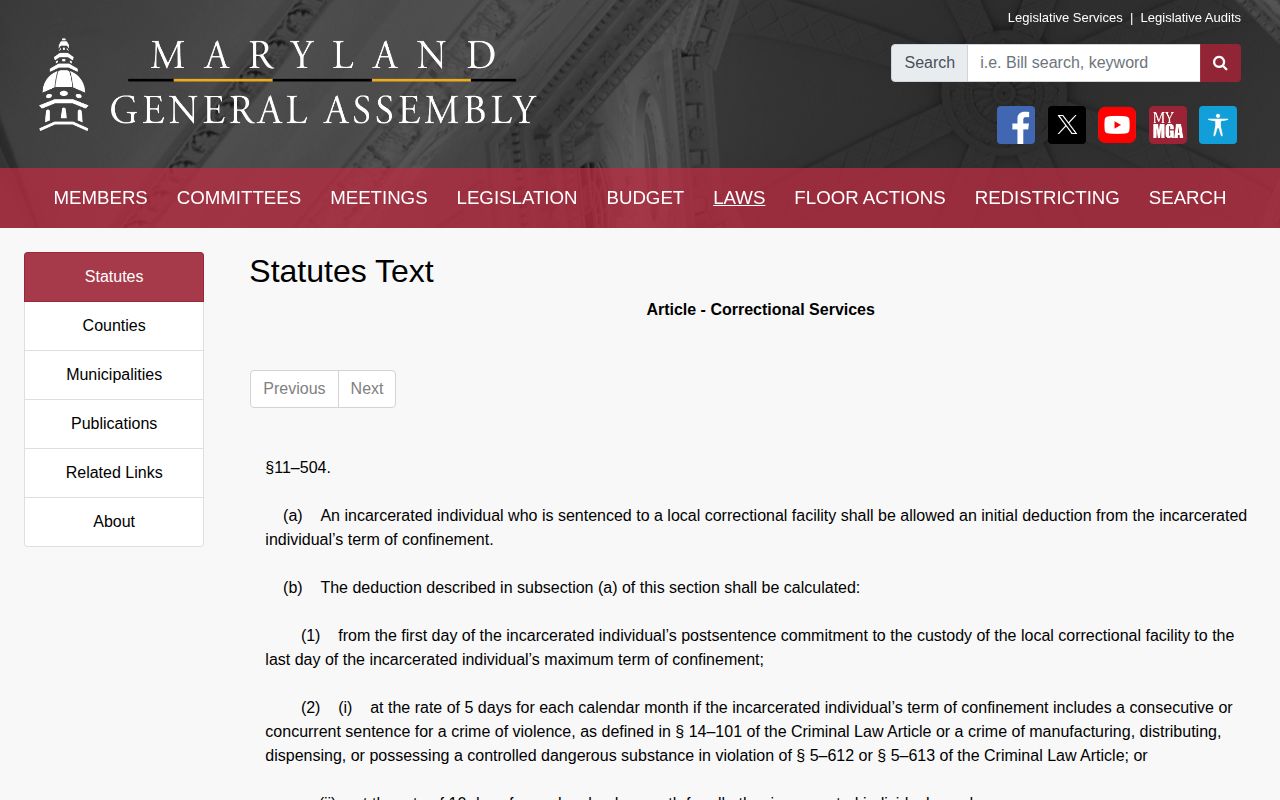
The local statute explains one input to a Prince George’s County sentence calculation, not an online release-date field.
Credits Follow Prince George’s Transfers
A move from Dille Drive to a Maryland prison is a sentence-calculation handoff. It is not a reset of the release clock. Under CS §11-508, accrued local credits follow a person transferred into DOC or another local correctional facility. Presentence and postsentence credits earned in Prince George’s County must therefore be reconciled with the receiving system’s record.
This is the county’s distinctive release-date issue. The Prince George’s County Release Unit records the departure from local custody, while the receiving institution continues the term. Describing the local exit as release to the community would be wrong. Ask PGCDOC whether the event was a transfer. Then ask the state institution for the updated computation that includes the carried credits.
- Presentence credit
- Eligible credit earned before sentencing while the person is confined.
- Postsentence credit
- Eligible credit applied after the court imposes a local sentence.
- Transfer
- A move to another custodial authority, not the end of confinement.
- Maximum term
- The court-imposed outer sentence limit before eligible credits and later changes.
Note: A Prince George’s transfer date and the receiving DOC institution’s projected date answer two different custody questions.
Prince George’s Release-Date Changes
A projected date can move for reasons beyond ordinary monthly credit. A court may modify the sentence. The institution can revoke or restore credit. A parole ruling can change conditional-release planning without proving that the person has physically left. Another authority can lodge a detainer, which is a request or legal basis to hold or transfer the person after the first custody term would otherwise end.
| Factor | Effect on the date or exit |
|---|---|
| Earned credit | May move the calculated date earlier within statutory limits. |
| Credit revocation or restoration | Moves the calculation later or restores previously lost time. |
| Court modification | Changes the controlling sentence term or credit direction. |
| Parole decision | May permit conditional release after conditions, but approval alone is not physical exit. |
| Detainer or other hold | Can lead to continued custody or transfer after the first term ends. |
| Concurrent or consecutive terms | Changes how multiple sentences overlap or run one after another. |
Maryland should not be described as having a blanket rule that every person must serve 85 percent. The statutes use offense-specific rates, other credit categories, caps, exclusions, and parole thresholds. Turning one five-day monthly rate into a universal percentage ignores the other lawful inputs and can produce a false Prince George’s County inmate release date.
Prince George’s Conditional Release Thresholds
Credits do not always lead straight to full discharge. Under CS §7-501, conditional release generally applies to qualifying DOC terms longer than 18 months when the maximum term is reduced by eligible credits. For violent crimes committed on or after October 1, 2009, conditional release cannot occur before the applicable parole-eligibility threshold. The person can leave confinement while remaining subject to legal conditions until the full term expires.
Parole eligibility is also not a projected release date. For an ordinary paroleable term of at least six months, eligibility generally begins after one-quarter of the aggregate sentence. Violent-crime, mandatory, nonparoleable, repeat-offense, and life-sentence rules can impose different thresholds. Eligibility only marks when lawful consideration can start. The Maryland Parole Commission may refuse, set a rehearing, or approve subject to unmet pre-release conditions. Approval does not prove physical exit.
Mandatory supervision has a similar distinction. The person has left confinement after applicable credit, yet remains in legal custody and subject to supervision until the maximum expiration date. A detainer can cause release from one sentence to end in another authority’s custody instead of the community. Ask the records office to identify both the calculated confinement date and the maximum expiration or supervision status.
This language matters for Prince George’s County records. “Released from Dille Drive,” “conditionally released by Maryland DOC,” and “sentence discharged” describe separate events. Each may have a different date and custodian. Verify which one the caller needs before requesting a record or interpreting a VINE message.
Confirm Prince George’s Actual Release
For a county sentence, ask PGCDOC for the actual release or transfer entry once the calculated date arrives. For a state sentence, contact the release institution or request the existing DPSCS record. A narrow Maryland Public Information Act request can seek the actual date, disposition, and receiving authority if releasable. Court dockets explain legal action, while the custodian’s entry shows what the facility did.
Maryland VINE can help with notice before a covered release or transfer. Its value is prospective, and the message must still be checked against the holding agency. The VINELink Release Check explains the one-person search, phone PIN, and alert-confirmation process. A release alert is useful evidence of a reported event, but it is not the final sentence computation or the official release record.
Note: Ask whether the person left custody, transferred, or began conditional supervision; each outcome changes the meaning of the recorded date.