
Prince George’s County VINELink Coverage
Maryland VINE is the statewide custody and notification layer used for a Prince George’s County VINELink release check. The service can be reached online, through its mobile app, or by telephone at 1-866-634-8463. TTY access is available at 1-866-847-1298. Official Maryland material says the service supports custody status, court-case status, protective-order status, and automated alerts. Those functions are broader than a simple jail roster, but VINELink remains a person-by-person tool. It is not a published list of everyone released from the Prince George’s County Correctional Center.
PGCDOC operates the county jail. The Sheriff does not run it. A Prince George’s County jail event should therefore be confirmed through PGCDOC Release & Records at 301-952-7158 or Records/Inmate Locator at 301-952-7102. For Maryland prison custody, the relevant source is DPSCS or the release institution. VINE may carry information from county and state sources, but it does not replace the source record. It also does not cover a federal Bureau of Prisons sentence as a BOP locator would.
Search Prince George’s VINELink Records
Start with the person’s full legal name. An offender number is stronger when it is known because names can be shared, misspelled, or entered with different spacing. The live Maryland interface is generated online and can change. Compare every identifier that appears before treating a match as the right person. A similar name is not enough. If several records appear, work from the custody agency, age or birth information when shown, offender number, and reported facility.
- Open the Maryland state page and choose the custody or offender search.
- Enter the legal first and last name, or use the offender number.
- Review every plausible match and compare the identifiers that are displayed.
- Open the matching record and read its current custody wording exactly.
- Note the source agency, location, event type, and any release information.
- Confirm a county exit with PGCDOC or a state event with DPSCS.
The official Maryland VINE brochure describes both search and notice options. The broader Prince George’s County released-inmate search path, including court and records-request checks, appears on the home page. That wider path matters when VINELink has no match or when the event must be proved with an agency record.
Note: Use an agency number when available, since common names can produce more than one plausible Prince George’s County VINE result.
Prince George’s VINELink Release Fields
Official material supports several kinds of information, but it does not publish one fixed dictionary for every live record. The wording can vary by source and event. A matching entry may provide custody status, reported facility, release information, and details used to register a future alert. Transcribe the result as it appears. Do not turn an unclear status into a universal “Released” label, and do not treat a blank field as proof that no event occurred.
| Field or item | How to read it |
|---|---|
| Name or offender number | Use it to distinguish the selected person from similar matches. |
| Custody status | Read the live phrase exactly and note whether it describes current custody or a change. |
| Reported facility | Shows the source facility or agency location when supplied. |
| Release information | May describe a release event or date, subject to source coverage and lag. |
| Notification options | Lists the available channels for future custody-change alerts. |
The live Maryland person-search page is the source for the interface shown below.
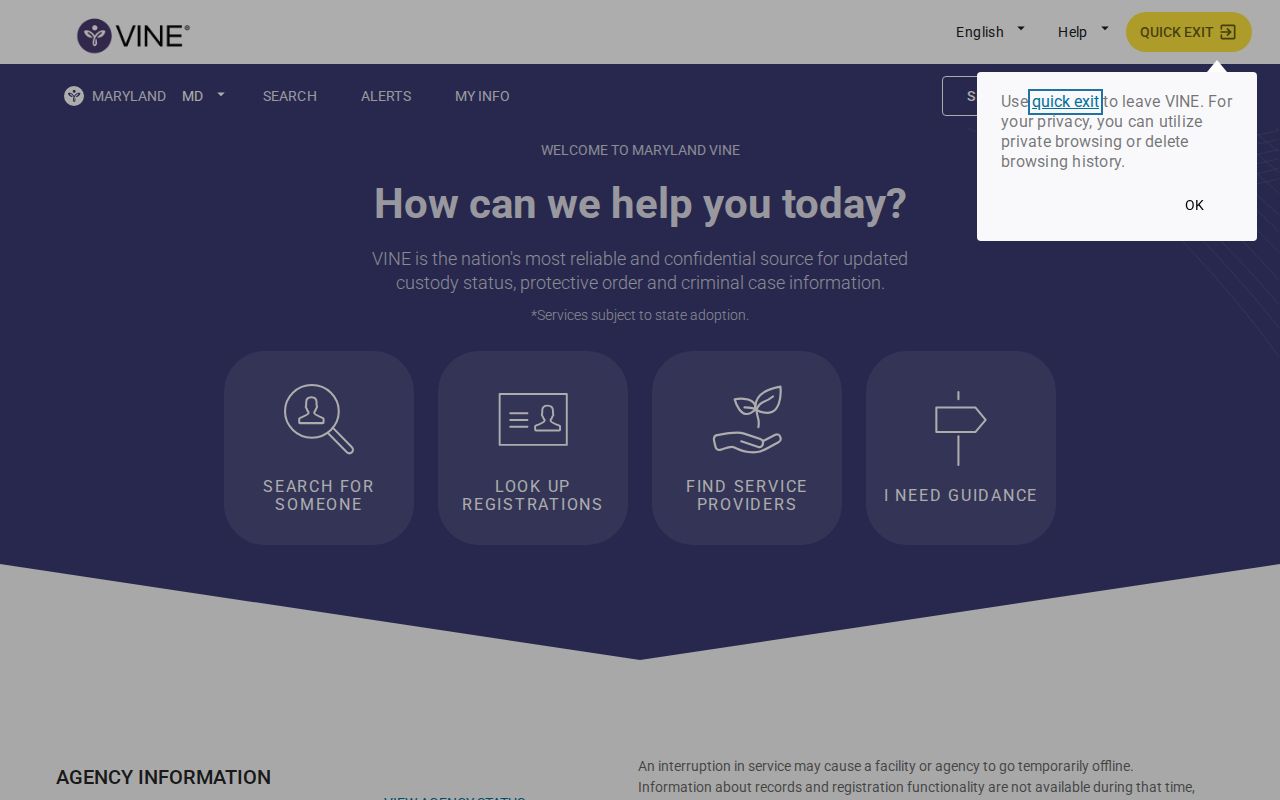
The image shows the correct Maryland entry point for a specific-person search and notification registration, not a countywide released-person feed.
Register Prince George’s Release Alerts
VINE works best before the expected event. After a confined person is found, select notification registration and enter the requested contact details. Maryland supports phone, email, text, TTY, and in-app notice methods. Registering more than one useful contact channel can reduce the risk of missing an event. Do not enter a switchboard or another number that cannot receive and confirm the call.
- Select the verified person record and open its notification options.
- Choose phone, email, text, TTY, or in-app notice as offered.
- Enter current contact details and review them for errors.
- For a phone alert, create the required four-digit PIN.
- When the automated call arrives, enter the PIN to confirm receipt.
- Update the registration when a number or address changes.
The four-digit PIN applies to phone registration. The research does not establish that email or text registration uses that same PIN, so it should not be assumed. If a phone PIN is lost, call the toll-free VINE number and press zero for a 24-hour operator. That operator can help reset a forgotten PIN or cancel an alert. The service may leave a message and keep trying for at least 24 hours until the phone recipient enters the PIN.
Note: A saved alert is prospective notice, not a certified Prince George’s County release record or proof of the legal basis for release.
Maryland’s Statewide VINE Layer
Prince George’s County does not publish a separate SAVIN portal in the official sources reviewed. Maryland VINE is the statewide layer. That local fact matters because a searcher should not expect a second county notification database with a different sign-in or a separate Prince George’s County alert history. Multiple phone numbers and email addresses may be registered through the statewide service, which makes advance setup more useful than trying to rebuild an old sequence after the person has left custody.
The current brochure lists release, escape, transfer, and probation or parole events. An older DPSCS page describes a narrower set of transfer notices. The safe reading is that event coverage can depend on the source facility and the data it sends. Do not promise that every Prince George’s County event will trigger every alert type. Keep the original message, note its time, and confirm the event with the source agency.
Missing Prince George’s VINELink Results
A no-result has several possible causes. The name may not match the intake record. The source may lag, the record may be unavailable, or the person may not fall within the service’s coverage. Later removal can also erase the path a searcher expected to find. None of those possibilities proves community release. A person who left the Prince George’s County jail could instead have transferred into Maryland state custody or been taken by another authority.
Call PGCDOC for a county event. Ask whether the person remains in county custody and, if not, whether the exit was a community release or a transfer. Then inspect Maryland Judiciary Case Search for the order or disposition that explains the legal change. For a current state transfer, use the DPSCS locator. For an actual past state discharge, contact the release institution or request the existing DPSCS record because Maryland’s public state locator removes people no longer in custody.
- Release
- An end to the named agency’s custody, which may or may not mean return to the community.
- Transfer
- A move from one custodial authority or facility to another, not a community release.
- Discharge
- The end of the sentence or legal custody obligation, distinct from conditional release.
- Notification
- An automated message about a reported event, not the underlying agency record.
Verify Prince George’s VINE Events
Keep the alert text or call details long enough to compare them with the source record. Record the time received, the named person, the source agency, and the event wording. Then call the agency on an official number obtained independently. For a Prince George’s County event, ask whether PGCDOC custody ended and whether the destination was the community, Maryland DOC, or another authority. This question is more precise than asking only whether someone was “released.”
The court docket can explain why a county stay ended. Look for bond action, dismissal, time served, a release order, a sentence, or a later modification. A court order still does not prove the exact door time because PGCDOC must complete its release checks. A new charge or hold may also change the result. When the exact time or destination matters, request the existing intake and release entry from Prince George’s County Corrections.
State events require a different check. A person may leave county custody by transfer and then appear as currently confined in the Maryland DPSCS locator. If the person later leaves state custody, the public locator removes the profile rather than preserving a released result. Ask the release institution or DPSCS for the discharge record, and use the Division of Parole and Probation when continuing supervision must be verified through a permitted channel.
Prospective notice and historical proof should not be confused. VINE is strongest when registration occurs while the person is confined. A later search may not reconstruct each old event or retain the labels once shown. A custodian’s release or transfer entry, paired with the court record, gives a more durable account of what happened.
Prince George’s VINELink Coverage Limits
VINELink is not the correct tool for every custody system. The BOP locator covers federal sentences and can preserve a past federal release date. ICE uses its own detainee locator, which may retain a recent ICE release for a limited period. The U.S. Marshals Service has no public prisoner-history locator. Those systems do not replace PGCDOC records for a county-only jail stay, and a Maryland VINE result should not be stretched to cover an unrelated federal event.
Maryland’s DPSCS locator has a different limit. It displays covered people who are currently held in the state system, not released profiles or projected dates. A current state match can show that a person who left Dille Drive was transferred rather than released to the community. No state-locator match is still ambiguous. For a pending Prince George’s County inmate release date, the separate Inmate Release Date coverage explains local and state calculation routes without claiming that the public locator shows a date.
Note: Confirm the exact agency, event, and destination before describing a Prince George’s County VINELink change as release to the community.